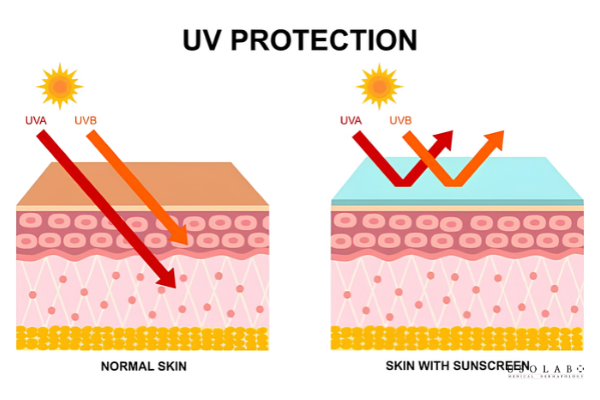
When completing their morning skincare routine, many people wonder whether to apply primer or sunscreen first to maximize skin protection and create a perfect makeup base. Confusing the order of these two steps not only leads to uneven, cakey, or clumpy skin, but more dangerously, it can disrupt the sun’s optical barrier, allowing UVA/UVB rays to easily penetrate, causing dark spots and premature aging. Understanding the biological mechanisms of each product from a cosmeceutical perspective will help you establish an accurate routine and preserve your skin’s natural protective barrier.
How do primer and sunscreen differ?
To accurately determine the order of product application on the epidermis, we need to clearly distinguish the functional nature and biological mechanisms of sunscreen and primer. Although both have a cream or gel texture for topical application, their target effects on the stratum corneum and superficial layers of the skin serve two completely separate purposes.
| Criteria | Sunscreen | Primer |
|---|---|---|
| Core mechanism | Create optical (physical/chemical) filters that absorb or reflect UV radiation. | Smoothes the surface of the stratum corneum, blurs pores, and absorbs excess sebum. |
| Classification of cycles | The final step in the skincare routine. | The first step in the entire makeup routine. |
| Biological purpose | Prevents photoaging, protects skin cell DNA, and reduces collagen breakdown. | Keeps makeup pigments evenly distributed, preventing foundation from smudging or sliding. |
| Characteristic ingredients | Organic/inorganic UV filters (Zinc Oxide, Titanium Dioxide, Tinosorb, etc.) | Silicone (Dimethicone, Cyclopentasiloxane), Polymer film, Smoothing Silica |
Should you apply primer or sunscreen first?
The unwavering rule, confirmed by doctors and dermatologists, is: Apply sunscreen FIRST, then apply primer. The skin’s natural mechanism prioritizes nourishing, treating, and forming a complete protective barrier before applying any surface makeup or chemical products.
Cơ chế hoạt động của màng lọc chống nắng trên tầng sừng
Kem chống nắng đòi hỏi sự liên kết phân tử trực tiếp với lớp lipid gian bào trên bề mặt biểu bì để trải đều thành một lớp màng đồng nhất, không đứt đoạn. Nếu bạn đảo ngược trật tự bằng cách bôi kem lót trước, lớp màng silicone dày đặc của kem lót sẽ tạo ra một hàng rào nhân tạo ngăn cản kem chống nắng thẩm thấu hoặc bám dính vào da. Hậu quả là màng lọc quang học bị xô lệch, xuất hiện nhiều khoảng hở khiến chỉ số SPF suy giảm nghiêm trọng so với thực tế ghi trên nhãn.
Things to Note When Using Sunscreen and Primer Together
The perfect combination of sunscreen and primer will give you a fresh, flawless look, but it also requires the right application technique to avoid clogged pores or unsightly clumping. To maximize the effectiveness of both products in the same morning, you need to remember the following clinical practice principles:
Wait Time: 3 to 5 minutes. Never apply primer immediately after applying sunscreen. Allow the sunscreen enough time to dry and form a stable optical film on the skin before proceeding to the next step.
Base Compatibility Rule: It’s best to combine products with the same base structure (water-based with water-based, silicone-based with silicone-based). Combining a lightweight, water-based sunscreen with a heavy, oil-based primer can easily cause a reaction that pushes the active ingredients out, creating a lumpy, piling-like effect.
Gently pat, not rub: Use your ring finger or a damp makeup sponge to gently pat the primer evenly in small dots. Avoid rubbing or rubbing vigorously, as friction will dislodge the freshly dried sunscreen layer.
Control the amount of primer: Only a small, pea-sized amount of primer is needed for the entire face, focusing mainly on the oily T-zone and the sides of the nose; applying too many layers will suffocate the skin and quickly clog pores.
How to choose the right sunscreen and primer for each skin type
Each skin type has different physiological characteristics and sensitivities to the active ingredients in the primer, therefore, the combination of products needs to be carefully individualized according to each specific skin type. Below is a suggested skincare routine from experts to help you choose the ideal product combination for each skin type:
Oily, combination oily, and acne-prone skin
Oily skin has overactive sebaceous glands, making it prone to oxidation, dullness, and clogged pores when multiple products are applied. For this skin type, you should prioritize lightweight, oil-controlling dermocosmetic sunscreens such as UsoLab Bio Sensitive Sun Block Matte 50ml – a formula containing a soothing and oil-controlling complex that dries instantly. This should be paired with a water-based gel primer containing oil-controlling ingredients like Niacinamide or Silica to keep pores clear all day long.
Dry, dehydrated, and aging skin
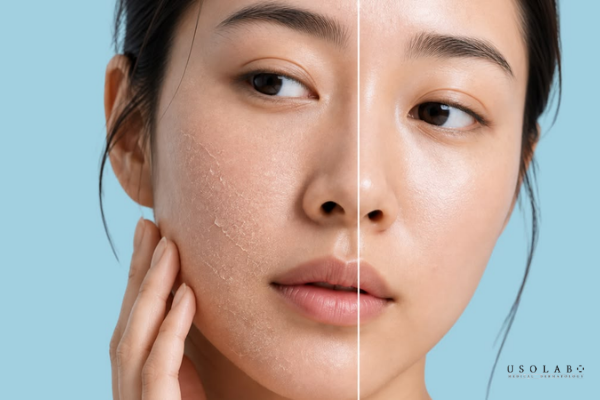
Dry skin often has a lack of moisture in the stratum corneum, easily peeling and creating fine lines if not properly softened. The optimal solution is to choose a broad-spectrum sunscreen rich in deeply moisturizing ingredients such as Hyaluronic Acid, Ceramide, or Peptide to restore the skin’s natural moisture barrier. The accompanying primer should be a hydrating primer rich in Glycerin or Vitamin E, which helps create a dewy, radiant complexion and effectively locks in moisture beneath makeup.
Sensitive skin or skin undergoing treatment
Skin after invasive procedures (peel, laser, microneedling) or undergoing high-activity treatments has an extremely fragile protective barrier, making it very susceptible to irritation from fragrances and drying alcohol. Choose a deeply restorative sunscreen containing gentle physical filters combined with anti-inflammatory and bio-restorative ingredients such as PDRN and Centella Asiatica extract. For primer, only use gentle mineral primers that are paraben-free and fragrance-free to provide maximum skin protection.
Common mistakes when using primer and sunscreen
Despite investing in expensive cosmetics, many people still experience persistent breakouts and makeup that quickly fades due to common mistakes. Identifying and eliminating the following unscientific practices will help you protect your skin health comprehensively:
Mixing primer and sunscreen to apply at once: Many people mistakenly believe that mixing the two products will save time, but in reality, this action disrupts the dispersion ratio of optical filters, dilutes the protection factor, and neutralizes the primer’s adhesion.
Believing that primer with SPF can replace sunscreen: Some primers contain SPF 15-20, but the amount of primer used daily is too small (just a small pea-sized amount), completely insufficient to meet the standard 2mg/cm² of skin surface to protect against harmful UV rays.
Applying primer while sunscreen is still wet: Rushing to apply primer before the sunscreen has dried will cause the two creams to mix unevenly, leading to foundation slipping, stickiness, and unsightly white streaks.
Don’t skip deep cleansing with double cleansing at the end of the day: The combination of durable sunscreen filters and deeply penetrating polymer particles in primer must be completely dissolved with a gentle makeup remover and a deep-cleansing facial wash to avoid sebum buildup and acne breakouts.
Remembering the rule of sunscreen first, then primer is fundamental to protecting your skin from the sun while achieving a smooth, radiant, and long-lasting makeup look all day. Choose high-quality, lightweight, and skin-friendly dermocosmetic sunscreens to ensure your skin is always cared for safely and professionally. Follow Usolab to stay updated on the latest skincare products.